
How Pinnacle's no-vig odds actually work
If you're going to find +EV bets, you need a reference price — something that says "this is what the true probability is." Pinnacle's no-vig odds are the closest thing the industry has to that reference. This lesson is what they are, why they work, and how to compute them yourself in five seconds of math.
Why Pinnacle is the reference book
Most sportsbooks make money the same way: they post odds with a built-in margin (the vig) and try to balance the action on both sides so they collect the margin regardless of outcome. Pinnacle does almost the opposite. They run a low-margin, high-volume operation that welcomes sharp bettors — including arbitragers — because the information sharp money brings to their lines is more valuable to them than the small losses they take on individual bets.
The result: Pinnacle's lines absorb sharp action almost in real time. Their closing line, especially, reflects the most accurate probability the market can produce. When other books are confused, Pinnacle isn't.
That's why Pinnacle is the reference. Not because their odds are always best — they're often worse for the bettor than promo-heavy US books. Because their odds are truest.
A quick recap on vig
A standard two-way market priced at -110 / -110 looks symmetric. It isn't. The implied probabilities work out to:
-
-110 → 52.4% implied
-
-110 → 52.4% implied
-
Total: 104.8%
That extra 4.8% is the vig — the book's margin. If the true probabilities are 50/50, the book pays you less than fair on a win and you pay them less than fair on a loss. Over time, that 4.8% becomes their profit.
A fair, no-vig market would have implied probabilities summing to exactly 100%. That's what we're after.
The math: equal-multiplier devigging
The most common method to strip vig is proportional (or equal-multiplier) devigging. The formula:
No-vig probability of side A = implied probability of A ÷ (implied A + implied B)
That's it. You're saying: take the two implied probabilities, normalize them so they sum to 1, and treat those normalized numbers as the fair probabilities.
Worked example
Pinnacle posts an NBA game:
-
Lakers -180 → implied 64.3%
-
Celtics +160 → implied 38.5%
-
Sum: 102.8% (about 2.8% vig)
Devig:
-
Lakers no-vig = 64.3 / 102.8 = 62.5%
-
Celtics no-vig = 38.5 / 102.8 = 37.5%
Sum: 100%. Clean.
Now those no-vig probabilities — 62.5% / 37.5% — are your fair-price estimate for the game. Convert back to odds and you get:
-
Lakers fair ≈ -167
-
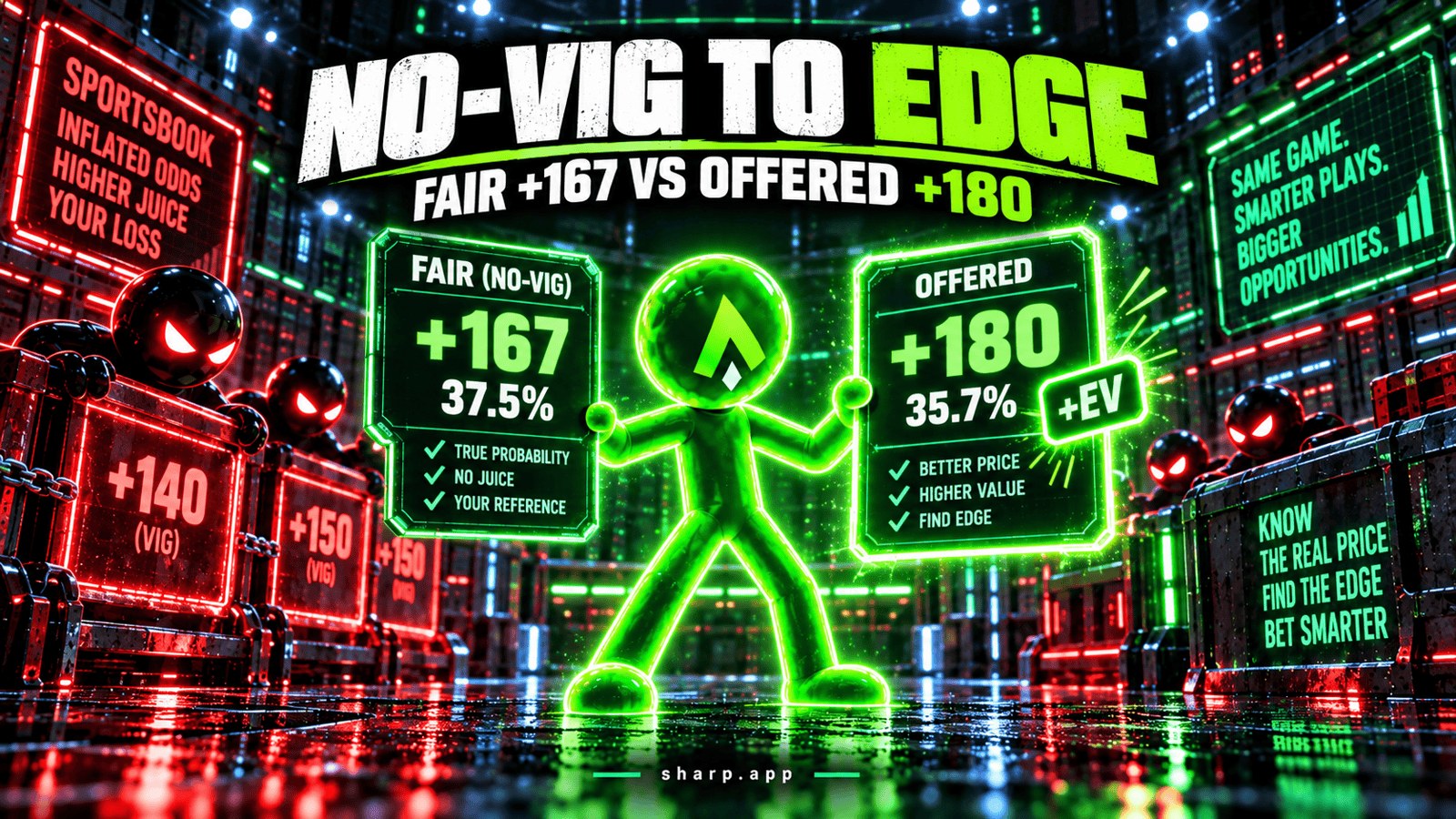
Celtics fair ≈ +167
Using the reference
You now go shop. Another sportsbook has the Celtics at +180. Compare:
-
Fair Celtics = +167 (implied 37.5%)
-
Offered Celtics = +180 (implied 35.7%)
The offered price implies a lower probability than fair, which means the payout is bigger than the true probability warrants. That's edge. Specifically:
- EV% = (offered probability × decimal payout) − 1 ≈ +5%
Roughly +5% EV on the Celtics +180. That's a bet worth making (subject to bankroll sizing — Lesson #9).
Why it works
Pinnacle's market efficiency means: even after their small vig is added, the proportions between the two sides are very close to the true probabilities. The vig is a uniform margin across both sides — devigging proportionally strips it cleanly. The result is a probability estimate the rest of the market doesn't reliably beat.
Where it breaks
A few honest limitations.
-
Three-way markets (e.g. soccer 1X2): proportional devigging is less accurate on three-way lines. The bias gets bigger for the draw. Use the power method or log-odds method instead — Lesson #7 covers them.
-
Heavy favorites / longshots: at extreme odds (-1000 / +700, etc.), the proportional method slightly under-prices the favorite and over-prices the dog. Small effect, but real.
-
Stale lines: Pinnacle isn't perfectly fast on every market. For niche props, the no-vig may not be a clean reference. Stick to main markets for clean reads.
-
Where Pinnacle isn't legal: most US states. Use offshore exchanges, Circa (in NV), or a proxy reference book that operates in your region.
The habit
Get this into a 10-second routine:
-
Find a bet candidate at any book.
-
Pull up Pinnacle's price (or Sharp's odds-comparison tool, which surfaces no-vig automatically).
-
Compute or read the no-vig probability.
-
Compare to the offered odds. If implied probability at the offered odds is lower than no-vig, you have edge.
Once this is muscle memory, finding +EV becomes a pattern-recognition skill, not a calculation chore.